
Quality Standards of Workshop Cabinets in Australia

Walk into a busy workshop mid-shift and you’ll see the difference immediately. Someone’s looking for consumables that should already be there. Another job pauses because stock isn’t where it’s expected. A cabinet sits nearby — organised, labelled — but not actually helping in that moment.
This isn’t unusual. It’s what happens when storage exists, but the system behind it doesn’t hold up under real conditions. Most workshop cabinets are assessed on what they can store, how they’re laid out, or how they look when everything is in place. But those factors don’t mean much once work starts moving, multiple people are accessing the same resources, and decisions are made under time pressure.
That’s where the real test begins.
A high-performance workshop cabinet system isn’t defined by its structure — it’s defined by how it behaves during operation. Whether it reduces friction or creates it. Whether it maintains control or slowly loses it. Whether people rely on it, or work around it.
This is where the gap exists across many workshop cabinets in Australia — not in having cabinets, but in whether those cabinets function as part of a system that can actually keep up with the way work gets done.

Cabinets vs Systems — The Distinction Most Workshops Miss
A cabinet on its own is just storage. It holds items, keeps them in one place, and may even look organised. But storage alone doesn’t guarantee availability, accountability, or efficiency. These only come from how the cabinet is used, maintained, and integrated into daily operations.
In high-performing workshops, cabinets are treated as part of a working system — not standalone equipment. That system includes how items are accessed, how usage is controlled, how stock is monitored, and how the setup adapts to real workflow demands.
Without that system around it, even a well-built cabinet becomes passive. It exists, but it doesn’t actively support the work.
Standard 1: It Aligns With Workflow — Not Against It
The first test is simple: does it help work move, or does it slow it down?
In real conditions, tradespeople will always default to the fastest option. If accessing consumables requires extra steps, distance, or waiting time, the system will gradually be bypassed. A high-performance setup is built around actual workflow — where work happens, how often items are used, and what peak demand looks like. Access should feel immediate, not restrictive.
Standard 2: It Maintains Control — Not Just Order
Organisation can give a false sense of control. A cabinet may look structured and labelled, but still fail to maintain accurate stock levels, consistent availability, and predictable replenishment. Control is not about how things look — it’s about whether the system prevents shortages, reduces overuse, and keeps operations predictable.
Standard 3: It Creates Accountability Without Resistance
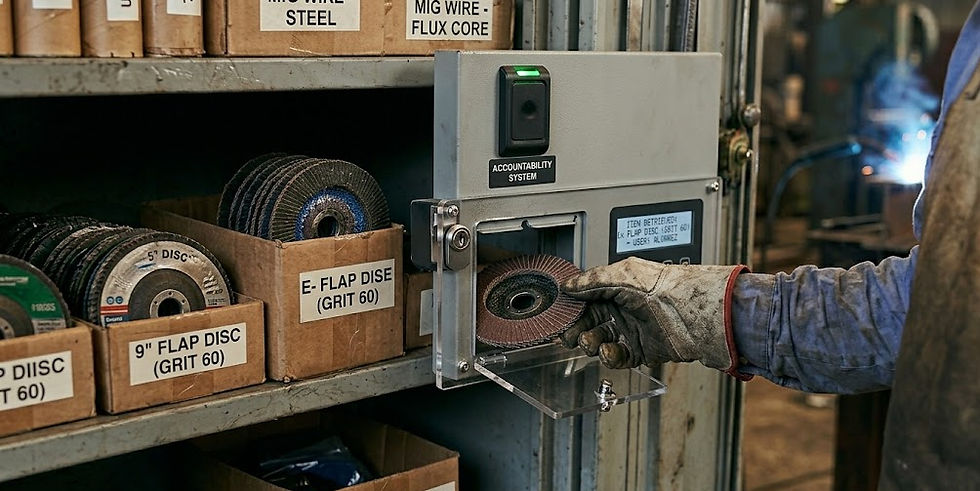
Accountability only works if people actually follow the system. If access is too restrictive or processes slow the job down, workarounds become normal. Over time, this breaks visibility and undermines control. A high-performing system makes accountability part of the process — not an extra step. It allows usage to be visible without interrupting workflow, so compliance happens naturally.
Standard 4: It Holds Up Across Shifts, Teams, and Conditions
Workshops are not consistent environments. Different teams, different habits, and varying levels of discipline mean systems must operate independently of individual behaviour. A reliable system maintains structure regardless of who is using it. It performs consistently across shifts and doesn’t rely on supervision to stay effective.
Standard 5: It Performs Under Real Workshop Conditions
Dust, heat, heavy handling, and constant use expose weaknesses quickly.
A system that works in controlled conditions but fails under pressure becomes a liability. Reliability here means consistent performance — not just durability, but dependable operation without frequent interruption.
Standard 6: It Adapts as the Workshop Changes
Workshops evolve — and systems must keep up. New jobs, different consumables, and changing workflows require flexibility. A rigid setup that cannot adjust becomes outdated quickly.
High-performance systems allow for changes without needing complete replacement. This often involves integration with broader workshop tools for storage cabinets that support evolving operational needs.
Standard 7: It Provides Visibility That Leads to Action
Tracking alone is not enough. Many systems collect data but don’t improve decision-making. As a result, workshops continue operating reactively — responding to issues after they happen.
Effective systems provide visibility that can be used to anticipate demand, identify inefficiencies, and plan ahead. The goal is not information — it’s control. This becomes especially important when managing specialised storage such as a PPE storage cabinet, where accessibility and compliance must align.
Standard 8: It Is Supported as an Ongoing System — Not a One-Time Setup
This is where many systems quietly fail. Cabinets are installed, stocked, and then left to operate on their own. Over time, small issues begin to appear. Stock levels drift. Usage patterns change. Workarounds develop.
Without ongoing adjustment, the system gradually moves away from how it was originally intended to function.
High-performing workshop systems are not self-sustaining. They are actively maintained — not just physically, but operationally. They are reviewed, adjusted, and aligned to how the workshop actually runs over time.
In more advanced setups, this may include integration with a welding supplies vending machine to maintain tighter control over high-usage consumables. The difference between a cabinet and a system is not in the hardware — it’s in how it is supported, managed, and refined in real conditions.
Comparison of Workshop Cabinet & Inventory Systems in Australia
Feature / Capability | WeldConnect – Full-Service Integrated | Tech-Based Vending & Inventory Systems | Traditional Cabinets & Storage |
Service & Support | Ongoing setup, review, workflow alignment | Technical support, remote diagnostics | Product delivery only |
Stock Control & Traceability | Usage tracking with audit logs, project linkage | Automated dispensing with records | Manual checks, ad hoc records |
Workflow Integration | Configured around workshop tasks | Can be standalone optimised vending points | Standard placement; depends on user setup |
Flexibility & Scalability | Adaptable to changes in workflow & inventory | Good for high-frequency items but less flexible layout | Physical storage only, limited workflow integration |
Data & Reporting | Actionable analytics for planning | Transaction-level logs & reporting | Limited or no digital data capture |
Compliance Support | Designed to meet workshop governance and audit needs | Vending data helps control access | Limited compliance support beyond lockout |
Use Case Suitability | Broad workshops with varied consumables | Sites with frequent high-use issues | Basic storage for tools & bulk items |
A Practical Test: Does the System Actually Work?
A high-performance system should be able to answer these clearly:
Are consumables consistently available when needed?
Do stock levels reflect actual usage?
Are people using the system without bypassing it?
Does it hold up during peak workload?
Can issues be identified before they impact production?
If the answer is inconsistent, the system may be in place — but it isn’t performing.
Security also plays a role. In many workshops, a lockable workshop cabinet helps reinforce control without restricting access.

Looking Ahead: Making Your Workshop System Work
In modern Australian workshops, expectations are shifting.
It’s no longer enough to have storage that looks organised or systems that appear structured on the surface. What matters is how those systems perform under real conditions — during pressure, across teams, and over time.
A high-performance workshop cabinet system is defined by consistency, usability, and its ability to support operations without becoming a point of friction. It maintains control without slowing work down, adapts as conditions change, and continues to function as intended long after installation.
For workshops evaluating their current setup or considering improvements, the focus should not be on what is installed, but on how it performs day to day — and whether it continues to deliver under the realities of the job.
FAQs: Workshop Cabinets in Australia
1. How do I know if our current workshop cabinet system is actually working?
If your team still experiences stockouts, inconsistent inventory levels, or regularly bypasses the system, it’s likely underperforming. A working system should operate consistently without needing constant correction.
2. Why do organised workshop cabinets still fail in practice?
Because organisation alone doesn’t ensure control. Without workflow alignment, usability, and ongoing management, systems break down under real conditions.
3. What should we look for in a workshop cabinet provider in Australia?
Look beyond the cabinet itself. A reliable provider should understand workshop operations, support implementation, and remain involved in maintaining and improving the system over time.


Comments