
Welding Safety: Practical Control of Fume and Gas Exposure

Most workshops don’t have a welding problem. They have an airflow problem.
Too many conversations about welding safety begin and end with PPE — respirators issued, cartridges replaced, boxes ticked. But airborne exposure is determined long before a mask is fitted. It is shaped by plume behaviour, capture velocity, ventilation design, gas displacement, and whether extraction systems are operating at the performance levels they were designed to deliver.
When welding fumes were formally classified as carcinogenic, the physics didn’t change. The expectations did. Across Australian worksites, welding safety requirements now demand more than visible controls. They demand systems that can be measured, maintained, and defended if questioned. Because once exposure is challenged — by a worker complaint, an insurer, or a regulator — the focus shifts immediately to one issue: Was the atmosphere controlled, or was protection assumed?

Exposure Under Australian Workplace Expectations
Under recognised welding safety requirements Australia, airborne contaminants generated during welding are a defined workplace hazard that must be assessed and controlled.
Exposure is not simply visible smoke. It is the measurable interaction between:
Airborne contaminant concentration
Duration of exposure
Ventilation effectiveness
Worker positioning relative to the plume
Atmospheric stability
Depending on process and material, welding may generate:
Metal particulates
Chromium compounds (stainless steel)
Zinc oxide (galvanised materials)
Ozone and nitrogen oxides
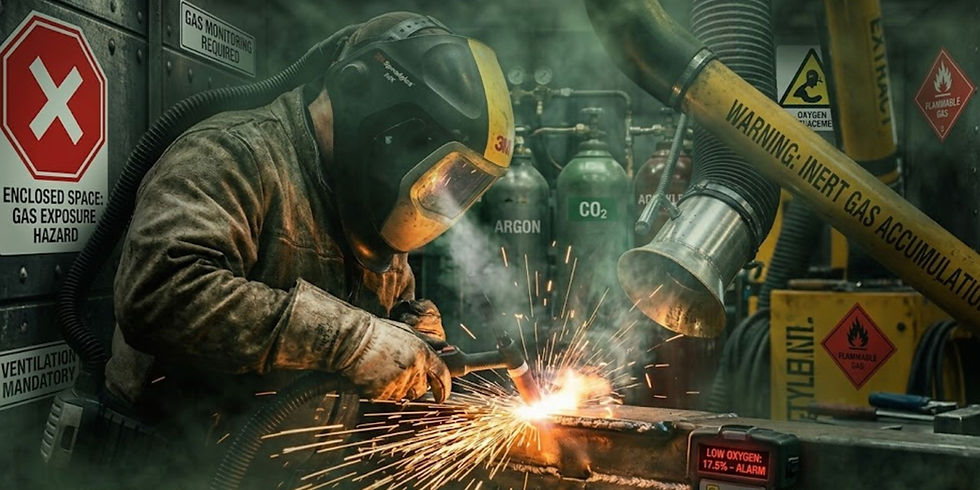
Shielding gases capable of oxygen displacement
In professional welding safety management, the correct question is:
What is entering the breathing zone — and at what concentration over time?
Health Evidence and Why It Matters
In 2017, the International Agency for Research on Cancer classified welding fumes as Group 1 carcinogenic to humans after reviewing epidemiological evidence linking long-term exposure to lung cancer.
Occupational health reviews referenced by Safe Work Australia also recognise elevated risks of:
Chronic bronchitis
Occupational asthma
Metal fume fever
Reduced long-term lung function
Respiratory illness in welders is rarely the result of one shift. It is the accumulation of unmanaged exposure over years.
For business owners and OHS managers, that risk extends beyond worker health:
Workers’ compensation claims
Insurance scrutiny
Legal liability
Regulator attention
Welding safety is therefore both a health obligation and a governance responsibility.

Engineering Controls Under Australian Standards
Recognised welding safety standards Australia frameworks apply the hierarchy of controls to airborne contaminants.
1. Local Exhaust Ventilation (LEV)
Source capture is the primary control measure. When positioned correctly near the arc, LEV removes contaminants before they enter the breathing zone.
Common failure points include:
Extraction arms placed too far from the plume
Clogged or saturated filters
Damaged ducting
Reduced fan performance
Lack of airflow verification
An installed system does not automatically meet compliance expectations. It must function effectively and be maintained.
2. General Ventilation
Dilution ventilation reduces background concentration but does not adequately control plume at source during high-fume processes. It supports welding safety systems. It does not replace source extraction.
When Respiratory Protection Becomes Necessary
Under a structured welding code of practice approach, respiratory PPE is required when engineering controls cannot sufficiently reduce exposure.
Situations typically include:
Confined or restricted spaces
Temporary worksites without installed extraction
High-fume materials
Maintenance or shutdown environments
Correct implementation requires:
Appropriate particulate filtration (e.g., P2 or higher where applicable)
Fit testing
Seal integrity
Maintenance scheduling
Documentation of selection rationale
Issuing respirators without verifying exposure levels or fit does not demonstrate defensible welding safety management.

Gas Exposure: The Overlooked Variable
Shielding gases such as argon and carbon dioxide are not toxic in normal concentrations, but they displace oxygen.
In enclosed or poorly ventilated environments:
Oxygen levels may fall below safe thresholds
Workers may experience impairment before recognising danger
Gas management — including hose integrity, regulator condition, and leak prevention — forms part of the broader welding safety control system.
The Role of Compliance-Aligned Suppliers
Modern welding safety is not just about supplying PPE or extraction equipment. It is about supporting defensible control systems.
Suppliers such as WeldConnect integrate compliance thinking into their advisory materials, recognising that airborne contaminant management must align with documented risk assessments and regulatory expectations.
In practice, this may include:
Correct specification of respiratory PPE
Matching extraction systems to application risk
Supporting inspection of gas equipment
Offering testing or verification services where required
Reinforcing documentation discipline
This shifts the supplier role from product distributor to system contributor.
What Regulators Examine
Authorities such as SafeWork NSW and WorkSafe Victoria assess welding safety by asking:
Was the airborne hazard identified?
Were engineering controls implemented?
Were they maintained and verified?
Was respiratory protection correctly selected?
Is documentation available?
They examine systems, not intentions.
Welding Safety Must Be Engineered and Defensible
Effective welding safety is defined by system control — not PPE distribution.
Strong management ensures that airborne exposure is:
Identified
Controlled at source
Supported by appropriate respiratory protection
Maintained through inspection
Documented for compliance
Under Australian workplace expectations, welding fumes and gases cannot be ignored or assumed controlled. If exposure exceeds acceptable limits, engineering controls and/or PPE must be implemented and verified. Respirators are visible. Airflow performance is not.
But when exposure is unmanaged over time, the consequences eventually become measurable — in health outcomes, compensation claims, and regulatory action.
That is why welding safety must be engineered, maintained, and defensible.
FAQs: Welding Fume and Gas Exposure
1. What are welding safety requirements in Australia regarding fumes?
Welding safety requirements Australia businesses operate under require airborne contaminants to be identified and controlled using the hierarchy of controls. This includes engineering measures such as local exhaust ventilation and suitable respiratory PPE where exposure remains.
2. Are respirators mandatory for all welding tasks?
No. Respirators are required when engineering controls cannot adequately reduce exposure below acceptable levels or when working in confined or poorly ventilated environments. The requirement must be risk-based and documented.
3. Is general workshop ventilation enough?
In most fabrication settings, general ventilation alone is insufficient. Effective welding safety typically requires source capture systems positioned near the arc.
4. What does a welding code of practice require for fume control?
A welding code of practice framework requires airborne hazards to be assessed and controlled. Where fumes or gases pose risk, suitable engineering controls and/or respiratory PPE must be implemented and maintained.
5. How often should extraction systems be inspected?
Inspection frequency depends on manufacturer guidance and site risk profile. However, systems must be maintained in working order and performance verified to meet compliance expectations.
Comments